For Residents
Stormwater runoff is water from rain or melting snow that “runs off” across impervious surfaces instead of seeping into the ground. This untreated runoff flows into the nearest storm inlet and is then carried to nearby waterways.
Materials such as pesticides, fertilizers, oil, and soaps are a few typical known pollutants, but soil, pet waste, grass clippings and leaves are also some of the many pollutants to water as well. As rain water or snow melt travels across impervious surfaces, pollutants are picked up and carried into the storm inlets which drain to nearby waterways such as streams, creeks, lakes, and rivers.
This is a phrase used for polluted runoff or other sources of water pollution that are hard to pinpoint the origin of the pollution. The term “nonpoint source pollution” comes from the federal Clean Water Act of 1987. In the Act, nonpoint source pollution is used to describe various types of water pollution that are not well-defined discharges (point sources) from wastewater plants or industries.
Many state agencies have nonpoint source (NPS) management programs that address polluted runoff. Nebraska’s NPS program is managed by the Nebraska Department of Environmental Quality (NDEQ). It serves as the central coordinating agency for the many NPS-related programs operated by various agencies.
Polluted stormwater runoff can occur anywhere people are using or altering the land. People going about their daily lives are the number one source of stormwater pollutants, and they are unaware of it. Common examples of people contributing to stormwater pollution include: over fertilizing, excessive pesticide usage, not picking up pet waste, using salt or sand to de-ice driveways, allowing oil to drip out of their vehicles and, of course, littering. If these pollutants are not properly used or picked up, then rainfall or snow melt will wash these pollutants into the storm inlets where they discharge into nearby waterways.
Polluted stormwater runoff is the number one cause of water pollution in Nebraska. In most cases, stormwater either does not receive any treatment before it enters waterways or if it does receive treatment, it is inadequately treated.
As the saying goes, “we all live downstream,” and polluted water creates numerous issues and costs to the public and wildlife. Communities that use surface water for their drinking supply must pay much more to have the polluted water cleaned and treated. The well-being and fate of wildlife in creeks, streams, rivers, and lakes is also compromised because of polluted water. Dirt from erosion, also called sediment, covers up fish habitat, fertilizers can cause nitrogen build up and cause too much algae to grow which decreases oxygen levels, and soaps harm fish skin and gills when pollutants enter waterways.
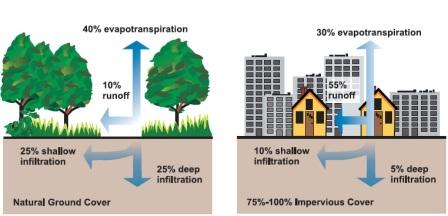
The amount of stormwater that enters into storm inlets is also a problem. When stormwater falls on impervious surfaces such as roads, roofs, driveways and parking lots, it cannot seep into the ground as it normally would and instead creates runoff. To give you an idea of the difference an impervious surface makes, consider the difference between one inch of rain falling onto a meadow and a parking lot – the runoff from a parking lot is 16 times the amount of runoff from a meadow!
Consequently, developed areas can experience localized flooding because of the increased amount of runoff from impervious surfaces. This high volume of water also causes stream banks to erode and washes the sediment into the water ultimately affecting the quality of the water and the well-being of wildlife.
Preventing pollution from entering waterways is much more affordable than cleaning polluted water. There are many different ways to keep pollutants out of runoff and to slow down high volumes of runoff by using “best management practices,” or BMPs. Educating residents about how to prevent pollution from entering waterways is one BMP. Another BMP is having laws in place to stop littering, enforce cleaning up after pets, and prohibit dumping oil or other substances into storm inlets. There are also laws that require people and businesses involved in earth disturbing activities –like construction and agriculture — to take steps to prevent erosion which is another way to prevent stormwater pollution.
Aside from education and law making, some BMPs can be constructed on property in order to help manage runoff and prevent pollutants from entering waterways. Detention ponds are one example of a BMP that is constructed to temporarily hold water so that it seeps into the ground slowly- these ponds fill up quickly after a rainstorm and allow solids like sediment and litter to settle at the pond bottom rather than be washed into storm inlets. Other examples of constructed BMPs are green roofs, storm drain grates, filter strips, rain gardens, and permeable pavement.
The federal Clean Water Act requires large and medium sized towns across the United States to take steps to reduce polluted stormwater runoff. The law was applied in two phases: The first phase addressed large cities and the second phase, often referred to as ”Phase II,” requires medium and small cities, fast growing cities and those located near sensitive waters to take steps to reduce stormwater. These laws require applicable cities to do six things:
- Conduct outreach and education about polluted stormwater runoff.
- Provide opportunities for residents to participate and be involved in conversations and activities related to reducing polluted stormwater runoff.
- Detect illicit discharges (e.g. straight piping or dumping).
- Control construction site runoff.
- Control post-construction runoff.
- Perform municipal housekeeping (e.g. take steps to prevent runoff from city buildings and activities.)
Streams and creeks feed into rivers, lakes and the ocean. Everyone uses and drinks water, so we are all affected when our water is polluted. When water treatment costs increase in order to filter and treat the water, the price of drinking water also increases. If you like to fish, swim or boat, you may have heard or been affected by advisories warning you not to swim, fish or boat in a certain area because of unhealthy water or too much algae – this is due to stormwater pollution. Businesses and homes can also be affected by stormwater whether you live near waterbodies or not – if the area around your establishment or home is not properly prepared for handling rainfall, you can risk a flood occurring from the runoff.
If you own a car, maintain it, so it does not leak oil or other fluids and if you wash the car at home, be sure to wash it on the grass or at a car wash, so the dirt and soap do not flow down the driveway and into the nearest storm drain.
If you own a yard, do not over fertilize your grass and never apply fertilizers or pesticides before a heavy rain. If fertilizer falls onto the driveway or sidewalks, sweep it up and throw it away or place back onto the grass. Make sure mulch, leaves, and grass clippings are not blown into or left in the street. Be sure to pick up all yard waste and place into a yard waste can at the curb or use it as compost to prevent yard waste from entering into the nearest storm drain.
Other things you can do to prevent runoff on your property is to turn your gutter downspouts away from hard surfaces – instead point them into flower beds, grassy areas, or consider building a rain garden to contain the water. To avoid erosion, seed or place sod down on bare spots in your yard.
If you have a septic system, maintain it properly by having it pumped every three to five years. If it is an older system, be sure it can still handle the volume placed on it today and never put any chemicals down septic systems – they can not only harm the system, but also can seep into the groundwater.
Pet owners should pick up after their pets and dispose of pet waste in the garbage.
Keep lawn and household chemicals tightly sealed and covered in a place where they will not get rained on. Dispose of old or unwanted chemicals at Under The Sink at 4001 South 12th Street. Visit https://www.underthesink.org/ for more information.
Never put anything down a storm inlet!
And of course, do not litter!
You can help reduce stormwater pollution by participating in the next stream cleanup in your area or by attending storm drain stenciling events – where the end destination of stormwater is clearly marked on the drain, so neighbors and others know the storm drain is only for rain. You can also attend public hearings or meetings on the topic so you can express your concerns and learn more. Also reporting any stormwater violations to your local government when you spot them will greatly help reduce stormwater pollution.
The City of Omaha has a comprehensive program comprised of various program elements and activities designed to reduce stormwater pollution to Maximum Extent Practicable (MEP) and eliminate prohibited non-stormwater discharges through a National Pollutant Discharge Elimination System (NPDES) municipal stormwater discharge permit. The comprehensive program includes pollution reduction activities for construction sites, industrial sites, illegal discharges and illicit connections, new developments, and municipal operations. The program also includes a public education effort through a number of public meetings and an annual water festival event.
The Papillion Creek Watershed Partnership (PCWP) is also an organization that participates in the efforts of the program. The PCWP covers a larger regional area of 402 square mile including the metropolitan areas of Douglas County, Sarpy County, Gretna, La Vista, Papillion, Ralston, Bellevue, Boys Town, and Bennington. More information on the Papillion Creek Watershed Partnership can be found at https://www.papiopartnership.org/.
Construction Related
There is a Construction Site creating a problem or mess, who do I contact to resolve this problem?
The active Construction Sites within the Papillion Creek Watershed are required to have a sign posted at the entrance to their project with contact information. The City of Omaha will also investigate complaints. You can file a complaint online or call the Environmental Quality Control Office at 402-444-3908.
Construction sites are required to keep the entrances to their project maintained. If track out occurs they are required to clean the streets. Most sites scrape the streets clean at the end of the day or throughout the day in some conditions. Sweeping, however, is not required. The standard that all sites are held to is to scrape the streets at least once a day.
Dust is an occurrence that will happen on most sites. During heavy grading, the contractors are required to maintain their entrances and haul roads. A reasonable effort must be made to control the dust from leaving the construction site. Areas that have been inactive or will be inactive in excess of 14 days need to have soil stabilization measures initiated.
No and yes. If your site isn’t part of a larger common plan of development greater than one acre you do not need to obtain a grading permit. You do however need to manage your site as needed to minimize construction stormwater discharges and other forms of pollution from the site. This can include the use of silt fence, wattles, stabilized entrances, diversion berms, temporary stabilization, etc…
Yes. When you obtain a grading permit, the requirements do not change during the year. You may not have to worry about as many rain events as you would in the Spring, but snow-melt, track-out from muddy sites, good housekeeping practices, etc… are always needed.
Post-Construction
A PCSMP is required when a project disturbs an area greater than 5,000 square feet. The exception to this requirement is if the project involves maintenance of a parking area with no change to the hydraulic grade.
If you are submitting a preliminary plat, you can meet the Preliminary Plat requirement by applying for a PCSMP project number in the Permix System. You won’t need to submit all the documentation until you are farther along in the design process.
Yes, projects that reduce the amount of impervious area will likely meet the no adverse impact requirement, but it doesn’t meet the conditions required for water quality treatment.
The recommended removal efficiency is 80% TSS removal. Since the City of Omaha does not have a protocol for mean grain size distribution, size the structure based on the 80% removal curves developed by each manufacturer.
As-built information required for a PCSMP should focus on information associated with the design and function of the BMP. Typical examples include (but aren’t limited to) invert elevations and spot elevations to ensure drainage flows in the design direction; elevations are also necessary to verify volumes for detention and bioretention areas.
Yes, if the project disturbs an area that is greater than 5,000 square feet and less than one acre, the owner may request a Hold on the Certificate of Occupancy contingent on providing a complete PCSMP. If the project is greater than one acre, a complete PCSMP is required for closure of the grading permit; as long as there is an approved Stormwater Pollution Prevention Plan (SWPPP) construction can begin before submitting PCSMP documents.
Industry/Commercial Related
The nature of activities on industrial and commercial facilities often involves bulk storage of chemicals, fuels, large volume equipment storage, and regular loading and unloading of materials. Due to these activities, there is an increased potential for stormwater to be exposed to pollutants. In addition, industrial and commercial facilities often have a high percentage of impervious surfaces at their site which leads to increased runoff that has a greater chance of picking up pollutants.
Federal regulations require stormwater discharges associated with specific sectors of industrial activity to be covered under the National Pollution Discharge Elimination System (NPDES) permits (unless otherwise excluded).
The permitting program is intended to identify and eliminate outdoor, exposed pollutants generated by businesses that are affecting, or could affect, the municipal separate storm sewer system and local waters.
Keeping pollutants out of the storm drainage system is important because pollutants, generated by businesses or other sources, are washed away to the nearby water bodies without receiving treatment to remove pollutants, so it will ultimately compromise the quality of our waters.
Industries subject to the stormwater regulations are identified by their Standard Industrial Classification (SIC) code. An industry is required to comply with the requirements of the stormwater regulations if at least one of its applicable SIC codes fall under one of the designated 30 sectors.
These 30 sectors are listed in Appendix D of Nebraska Department of Environmental Quality (NDEQ) Industrial Stormwater (ISW) Permit.
For Engineering Firms
Any grading site that is greater than or equal to 5 acres of disturbed ground (note: Disturbed ground means any area that will be and/or is without vegetative cover) will be considered a Phase 1 Grading Permit (GR1) and therefore eligible for stage based reporting.
- Stage 1
- Site Inspections must be performed as follows:
- within 24 hours of a storm event equal to or greater than 0.5 inches
- within 9 days of the last site inspection conducted
- The Reporting Period ending dates correspond to the following:
- each Saturday of each month
- Sites meeting the following condition must adhere to stage 1 site inspection and reporting requirements:
- All sites not qualifying for stage 2, 3, or 4 inspection requirements.
- Site Inspections must be performed as follows:
- Stage 2
- Site Inspections must be performed as follows:
- within 24 hours of a storm event equal to or greater than 0.5 inches and
- within 19 days of the last site inspection conducted.
- The Reporting Period ending dates correspond to the following:
- the second Saturday of each month and
- the fourth Saturday of each month.
- Sites meeting all of the following conditions can adhere to stage 2 site inspection and reporting requirements:
- All sedimentation and erosion control measures have been installed and functioning correctly.
- All inspection reports are up to date and accurate.
- All site grading has been completed in accordance with the SWPPP (note: minimal utility and/or building pad excavation may be conducted).
- Vegetative ground cover has been fully established.
- The CITY OF OMAHA Inspector assigned to the site has allowed the transition to Stage 2 site inspection and reporting requirements.
- Site Inspections must be performed as follows:
- Stage 3
- Site Inspections must be performed as follows:
- within 24 hours of a storm event equal to or greater than 0.5 inches and
- within 38 days of the last site inspection conducted.
- The Reporting Period ending dates correspond to the following:
- the second Saturday of each month.
- Sites meeting all of the following conditions can adhere to stage 3 site inspection and reporting requirements:
- Items 2.c.i thru 2.c.iv. are in compliance.
- All public Improvements have been installed.
- The CITY OF OMAHA Inspector assigned to the site has allowed the transition to Stage 3 site inspection and reporting requirements.
- Site Inspections must be performed as follows:
- Stage 4 (note: also referred to as winter stage)
- Site Inspections must be performed as follows:
- within 24 hours of a storm event equal to or greater than 0.5 inch and
- within 38 days of the last site inspection conducted.
- The Reporting Period ending dates correspond to the following:
- the second Saturday of each month.
- Stage 4 inspecting and reporting requirements shall only be applicable during December 1 through March 1. After March 1 site inspection and reporting requirements shall revert to the applicable requirements in use prior to December 1.
- Sites meeting all of the following conditions can adhere to stage 4 site inspection and reporting requirements:
- Items 2.c.i thru 2.c.iv. are in compliance.
- The request has been submitted before December 1
- Runoff is unlikely due to winter conditions (e.g., site must be covered with snow, ice, or the ground is frozen)
- The CITY OF OMAHA Inspector assigned to the site has allowed the transition to Stage 4 site inspection and reporting requirements
- Site Inspections must be performed as follows:
After a report for any site is submitted, a link should appear to request a stage change. Click the link and select the stage you feel the site should be assigned. A city inspector is notified that a stage change was requested and will inspect the site. The city inspector will then notify the Inspecting Engineer Representative if the stage will be changed or what needs to be completed before the stage change will be granted.
Any construction project that will result in the stripping, grading, or other ground disturbing activities over 1 acre in size must apply for a permit. Sites under an acre are still required to control erosion and minimize sediment loss.